The Groom
A day aloft with the travelling groom
One trained person stays within a few metres of the stall for the whole flight, and that day looks like no other day in horses.
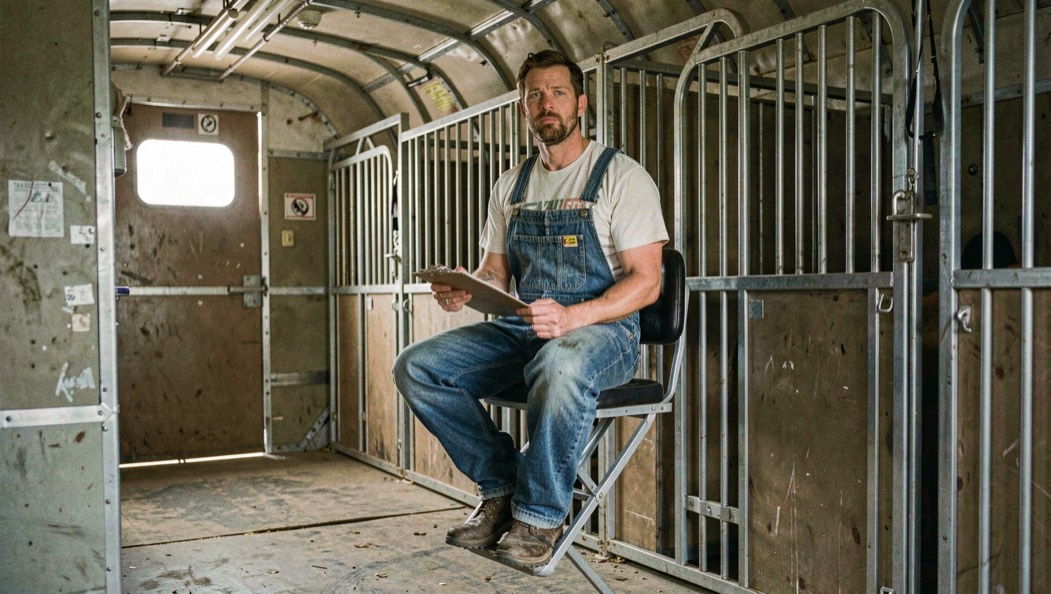
On a horse freighter the animals are not unaccompanied cargo. Somebody travels with them, on the main deck, close enough to see and touch every stall. That person is the attendant, usually called the flying groom, and the day is long, unglamorous and almost entirely about watching.
Before the aircraft: the part that takes longest
The groom's day starts hours before departure and on the ground. Horses arrive by road at the cargo terminal, are checked against their documents, and are loaded into the jet stalls on the apron rather than inside the aircraft. Hay is hung, water is filled, partitions are set, and the stall is closed and inspected before a high loader raises the whole assembly to main deck level. A stall that has to be reopened once it is aboard is a problem, so everything the groom will need in flight is placed in reach beforehand. The ground part is also where the attendant meets the animals for the first time if they are not from the home yard, and the few minutes spent at each head before loading are the baseline the whole flight will be read against.
The seat, and what it means
The attendant is not in the passenger cabin. On a freighter there are a small number of supernumerary seats, and the groom occupies one of them with access to the main deck. IATA's own change list for the Live Animals Regulations records amendments to section 10.4.1 giving "further clarity on specific handling procedures for horses", which is the section governing how those animals are handled once they are the crew's responsibility. In practice, being a few metres from the stall is the whole point: nothing can be delegated to a camera. The seat also means the attendant is under the captain's authority like any other person aboard, strapped in when the crew says so and out of the way when the crew is working the deck.
What are the checks, actually?
Six things, looked at rather than measured, on a schedule rather than when something seems wrong.
- Head carriage and demeanour, compared against the animal's own baseline rather than a general idea of calm.
- Respiration, watched rather than counted, and any change after a turn or a climb.
- Sweat, and whether it is drying or spreading.
- Hay consumption, which is the simplest honest indicator that a horse has settled.
- Water offered on a schedule and refused or taken, both of which are worth writing down.
- Bedding and footing, because a horse that has been shifting has usually been bracing.
The log is the deliverable. A groom who lands with a clean, timed record of what each animal ate, drank and did hands the receiving veterinarian something no camera provides. A groom who lands with a memory hands over an opinion.
Turbulence, climb and descent
The moments that ask most of a horse are not the cruise. They are the ones with a change of attitude: rotation, the first climb, and the descent. A horse braces against acceleration in the same way it braces in a lorry, but without being able to see the road ahead. The attendant's job during those phases is to be visible and undramatic, and to be strapped in when the crew requires it. Nothing useful is achieved by opening a stall in turbulence, and a good deal of harm can be: a gate opened on a bracing horse is a gate that may not close again until the aircraft is level. The useful work in those minutes is done with the eyes, and written down as soon as the seat belt sign allows.
What happens at the technical stop and the handover?
If the routing includes a fuel stop, the animals stay loaded and the hold stays shut, and the groom keeps the log through an hour that is noisier and hotter than the cruise, offering water while the aircraft is still and watching for the horse that reads the silence as arrival. At destination the day still is not over: the stalls come off, the animals are checked against their documents by the receiving authority, and the attendant hands over both the horses and the record. In most destinations the horse then goes straight into quarantine rather than to a stable of its own, and the attendant's last useful act is to tell the receiving veterinarian, in a sentence, which animal to watch first and why.
What this page does not claim
This is a general account of the role, not a description of any particular airline's procedures, and it is not a training document. Crew instructions, restraint requirements and access rules are set by the operator and by the captain, and they differ between aircraft types. No flight time, check interval or seat arrangement given here is a standard. The illustration is a produced image, not a photograph of a named flight or person.
Sources read on 5 September 2026: IATA, Significant Changes and Amendments to the 49th Edition of the Live Animals Regulations. What the person in that seat must hold is set out in what a flying groom must hold; what the record looks like is on the flight log.