The flight log
The flight log
The only thing that leaves the aircraft with the horse and tells the next person what actually happened.
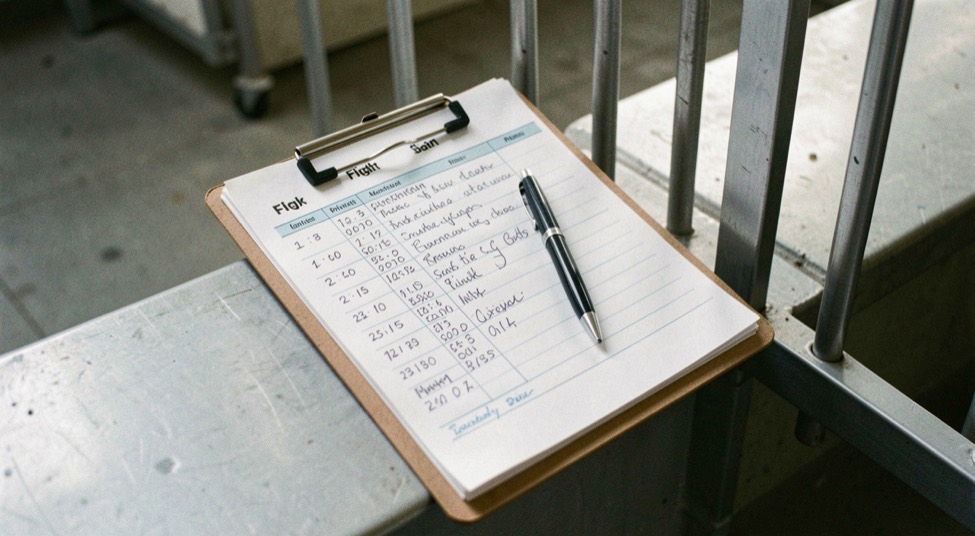
Everything else about a horse flight is arranged in advance. The log is the only document created during it, and it is the only account the receiving veterinarian has of ten or fifteen hours nobody else witnessed. A good one takes a few seconds an hour to keep and changes what happens at the other end. A bad one is a memory, offered after the fact, by somebody who has not slept.
Why does the record matter more than the recollection?
Because the horse arriving in quarantine is examined by people who have never seen it before. They have no baseline. Whether this animal normally eats through transport, whether it habitually refuses water away from home, whether the sweat on its flank appeared at rotation or after the fuel stop, are all questions that decide whether the next twelve hours are watchful or routine. Only the attendant can answer them, and only if the answers were written at the time. A recollection offered on the ramp after a night without sleep is sincere and unreliable in equal measure, and the receiving veterinarian knows it.
What a usable log contains
- A baseline, written before departure. The animal's normal demeanour, resting respiration and eating habit, taken at the yard rather than at the terminal.
- Times, in one time zone, stated at the top. A log that drifts between local times at origin and destination is unreadable at the moment it matters.
- Hay: offered, and how much was gone at each check. The simplest honest indicator that a horse has settled.
- Water: offered, and taken or refused. Refusal in flight is common and is not by itself alarming; refusal together with a stopped haynet is another matter.
- Droppings and urination, with times. Unglamorous and the first thing the receiving veterinarian asks about.
- Demeanour at the phases that ask most: rotation, first climb, descent, and the technical stop.
- Anything done, with the time. A net retied, a rug removed, a bucket refilled.
- Anything not done, and why. Turbulence, crew instruction, deck activity during the stop.
How the record is laid out
One sheet per animal, or one column per animal on a shared sheet, with the stall position written against the name so that the receiving team can walk the deck in order. The baseline sits at the top, above the first timed entry, so that anyone reading later sees the normal before the flight. Entries are short, timed and factual: a quantity, a yes or no, a word for demeanour. Adjectives are kept for the remarks column, and the remarks column is used sparingly. A log written this way can be read in a minute by someone standing at a ramp, which is the whole point of it.
The entries people forget
Three omissions recur. The first is the baseline, because it has to be written before the day gets busy. The second is the negative observation: a note that a horse ate normally throughout is as useful as a note that it did not, and only one of them tends to get written. The third is the handover itself, with the time the stalls came off and the time the animals were seen by the receiving authority, which is what closes the record. A fourth, less common and more costly, is the change of time zone halfway down the page, which turns a good log into two logs that do not agree.
Who reads it afterwards?
The receiving veterinarian and the quarantine facility read it first, usually before the horse is touched. The owner reads it later, often to understand a horse that has come off the flight flat. And where anything goes wrong, the log is the contemporaneous record of what was done, which is a different thing from an account written afterwards by someone with an interest in the outcome. That alone is a reason to keep it plainly, in ink, with times, and to hand a copy over rather than the only original.
What this page does not claim
This is a practical account of good record keeping, not a form required by any authority and not veterinary advice. Carriers and destination facilities may require their own documentation in addition, and where they do, their form comes first and this list is a supplement to it. No template is offered for download because a template that does not match the carrier's form would be a second document to reconcile. The illustration is a produced image, not a photograph of a real flight record.
The role that keeps this record is described in the travelling groom, the day it covers in a day aloft with the travelling groom, and the hour it is hardest to keep in technical stops on the ramp.