Quarantine
Quarantine
The part of the timetable that cannot be shortened by paying more, and the part buyers plan for last.
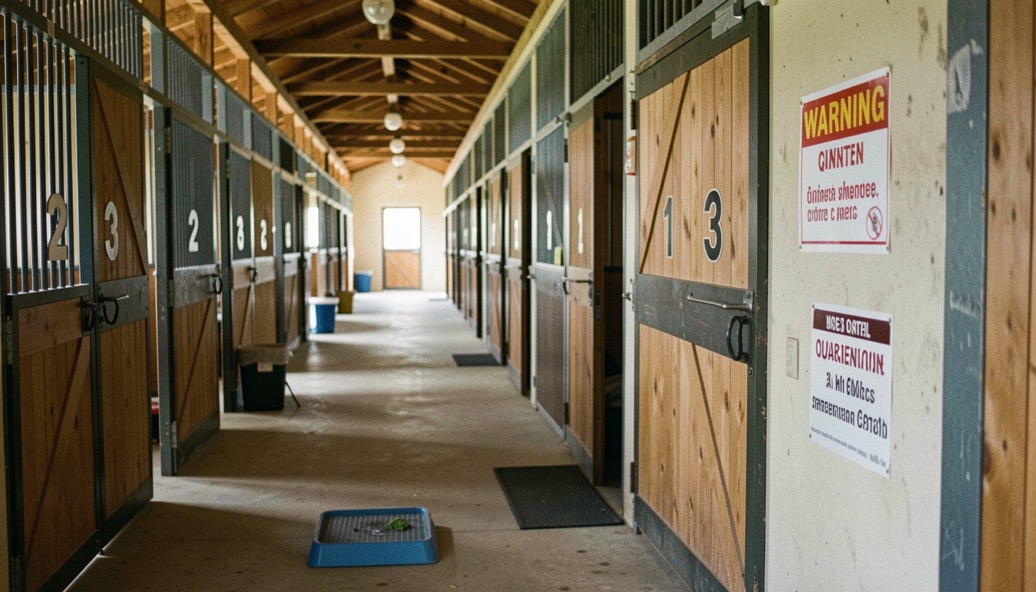
Quarantine is the least negotiable part of an air shipment. The flight can be rebooked, the stall can be shared differently, the route can change; the number of days behind the fence is set by the destination and applies to every animal in its category. It is also the part that is usually reserved before the horse leaves, which means a quarantine place is part of the purchase, not part of the arrival.
Days, not adjectives
The United States publishes three possible durations, 3 days, 7 days or 60 days, determined by the animal health status of the countries the horse lived in during the 60 days before import, the countries transited, and the purpose of entry. Australia requires a minimum of 14 days of post arrival quarantine for horses from approved countries other than New Zealand and New Caledonia, preceded by 14 days of pre export isolation, extended to 21 days for horses from the United Arab Emirates. Those are the figures; everything else on the subject is commentary on them.
Why can the same horse fall into two categories?
Because the clock that decides the quarantine started long before the booking. A horse that spent part of the preceding two months in a country with a different disease status has changed its own category without moving an inch towards an airport, and a transit stop can do the same. The purpose of entry counts too: the same animal arriving to compete and arriving to stay are not the same import. This is why the honest way to read a timetable is backwards from the date the animal is needed, adding pre export isolation, flight, arrival quarantine and, if a laboratory result is not negative, the retest calendar on top.
The reservation is part of the import
Where the destination requires a quarantine place, the space is reserved before the animal is exported, and for the long African horse sickness quarantine in the United States the places are in a small number of purpose built centres. A confirmed flight with no confirmed box on the ground is not a confirmed journey. The reservation is also where the calendar becomes fixed: a facility booked for a date is a facility that expects the horse on that date, and a slipped flight can mean a lost place rather than a late arrival.
What does the separate breeding regime add?
A second facility, a second bill and several more weeks, for entire horses only. In the United States, a sexually intact horse over 731 days old from a region affected by contagious equine metritis goes through a state approved facility where a mare is swabbed repeatedly over a twelve day period and a stallion is test bred to two resident mares whose own results fall between days 21 and 28 after breeding. Gelding before export removes the regime entirely, which makes it a commercial decision taken before the purchase, not a veterinary one taken after landing.
What quarantine is protecting
The durations track incubation periods and vector seasons for the diseases the destination is guarding against, and how far it trusts the origin's surveillance. A short quarantine says the origin is trusted and the remaining risk is the animal. A sixty day quarantine says the risk is the disease situation of the origin, and that no individual result shortens it. Reading the number that way makes it predictable rather than arbitrary, and predictable is what a timetable needs.
What the two chapters in this section cover
The first sets out ordinary arrival quarantine for two destinations that publish clearly, and explains why the long sixty day case exists. The second covers a regime most owners never meet and breeders always do: contagious equine metritis quarantine, which applies to entire horses over 731 days old from affected regions and which, for a stallion, involves two resident test mares and a calendar running past four weeks after landing. Both chapters give the figures as the authorities publish them and date the reading.
Read next in this ledger
02Chapters in this section
The ordinary import quarantine, and the separate regime for breeding stock.
-
Arrival quarantine, country by country
The flight ends at the ramp. The paperwork ends days or weeks later, behind a fence the destination country has drawn.
Quarantine
-
CEM quarantine for breeding horses
A second quarantine that has nothing to do with the flight, applies only to entire horses, and involves two test mares.
Quarantine