Export Papers
Blood tests and their windows
Four diseases, four named laboratory methods, and a retest calendar that can hold a horse for weeks after it lands.
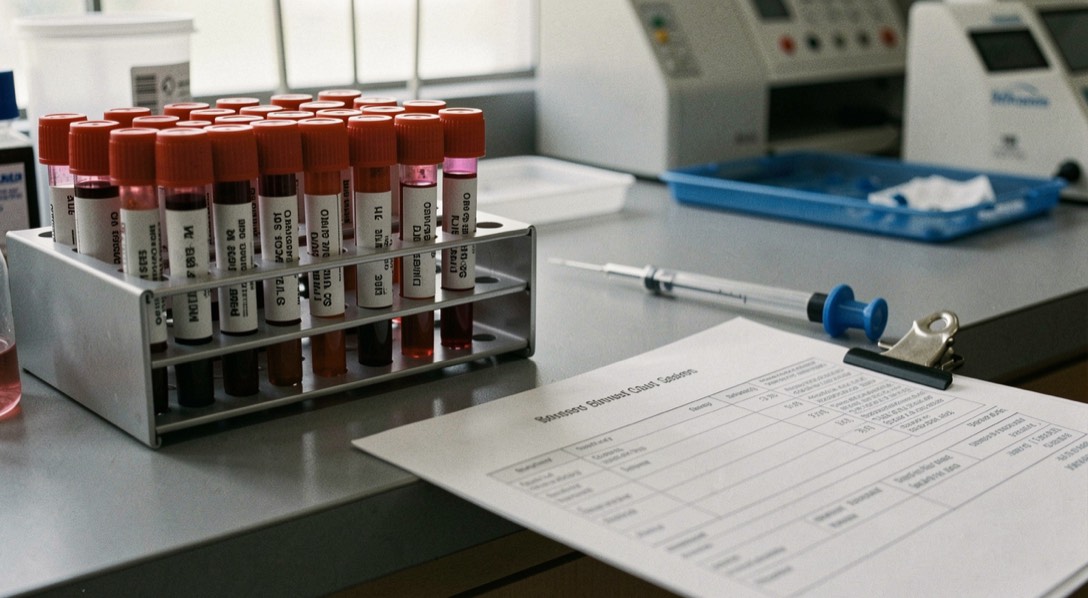
Most accounts of horse export mention "blood tests" and move on. The detail is where the delays live. The United States publishes exactly which diseases it screens for on import, which laboratory method it uses for each, and what happens when a result comes back anything other than negative. It is one of the most useful documents in the whole subject, and it is a two page information sheet almost nobody links to.
The four diseases and their named methods
The Animal and Plant Health Inspection Service states that horses presented for import "undergo testing for the following foreign animal diseases (FADs): dourine, equine infectious anemia (EIA), equine piroplasmosis (EP), and glanders", that the National Veterinary Services Laboratories conducts and analyses all tests, and that "A horse must be classified as negative for these FADs before they enter the United States".
| Disease | Official method | Result classes |
|---|---|---|
| Dourine (Trypanosoma equiperdum) | Complement fixation test | Positive, suspect or negative |
| Equine infectious anaemia | Agar gel immunodiffusion | Positive or negative, no suspect |
| Equine piroplasmosis | Complement fixation test and competitive ELISA, both must be negative | Positive or negative, no suspect |
| Glanders (Burkholderia mallei) | Double antigen ELISA, with Western blot confirmation | Positive or negative, no suspect |
The reason piroplasmosis takes two tests is stated in the same document: "the cELISA targets chronic cases of EP and CFT targets earlier infections". A single method would miss part of the picture, so both must be negative for the animal to be classified negative.
What happens when a result is not negative?
This is the part that turns a three day quarantine into a month. For dourine, piroplasmosis and glanders, a non negative result triggers an immediate second sample. If that is also non negative, the published protocol is that "the horse may be held in quarantine for up to 28 days and retested up to twice more at 14-day intervals". A negative at any stage classifies the horse as negative. If the results remain non negative, entry is refused with no further retest.
Equine infectious anaemia is handled differently and more harshly. There is no suspect class. On an initial positive, the laboratory retests the same sample and a freshly collected one; if positive again, the horse is refused entry. Release after an initial positive requires negative results on two sequential subsequent tests.
The rule that catches the other horses on the flight
Shippers rarely consider what a stablemate's result does to their own animal. Animals in the same shipment as a horse classified positive or suspect may be treated as cohorts. The published consequence differs by disease: cohorts of a horse positive for equine infectious anaemia are refused entry; cohorts for dourine, piroplasmosis or glanders "will be held in quarantine for 14 days from initial blood collection and then retested" and may be released if all retest results are negative. If a cohort horse tests positive for glanders, the entire shipment is refused.
Booking a share of a stall with unknown horses is also booking a share of their laboratory results.
Two technical details worth knowing before you argue with a result
A complement fixation test can return an anticomplementary result, meaning no valid readable result at all. The published response is supplemental testing by immunofluorescence assay rather than an automatic refusal. And for Babesia caballi, a horse positive on the competitive ELISA but negative on the Western blot confirmatory test is classified as negative. Both details exist because a screening system deliberately errs towards catching cases, and needs a route back for animals caught wrongly. They also explain why a first result is rarely the end of the story: the protocol is built as a sequence of samples, and the question the laboratory is answering at each step is whether the animal can be classified negative, not whether a single number crossed a line.
Why does the window matter more than the test?
Because the tests above are United States import tests, performed after arrival by a federal laboratory, and they are only half of the calendar. Separately, the destination's import conditions and the exporting authority's certificate set out which samples must be drawn before departure and how recent they must be. Those pre export windows are counted from the date of sampling, not the date of the result, and a laboratory turnaround that slips can expire a sample that was drawn correctly. A window of a few weeks sounds generous until it is laid against a certificate deadline counted in working days, a booked pallet position and a reserved quarantine place, each with its own date. The calendar, not the needle, is what usually misses the flight, and the way to protect it is to draw the samples at the latest safe point rather than the earliest convenient one.
What this page does not claim
The table above describes the United States import testing protocol as published by APHIS. It is not the list of tests required by every destination, and it is not veterinary advice. Requirements vary by country of residence, by transit and by purpose of entry, and they are revised; the document quoted here carries no date of its own, so the date given below is the date it was read, not the date it was issued.
Sources read on 5 September 2026: APHIS Veterinary Services, USDA Import Testing of Horses; APHIS, Importing Live Equines and Equine Germplasm into the United States, page updated 14 August 2026. The certificate these samples feed is described on the export health certificate.