Export Papers
The export health certificate
One sheet of paper with a chain of signatures behind it, each with its own deadline and its own signatory.
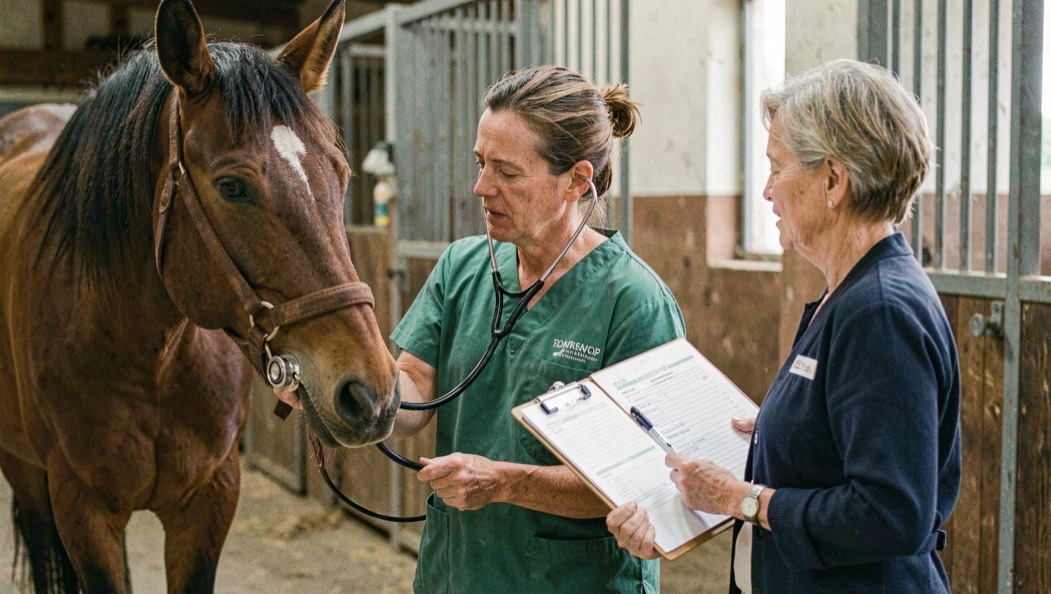
The export health certificate is the document that turns a horse into a consignment. Without it the animal is not refused at the aircraft; it is refused much earlier, because no carrier will accept a live animal booking that has no certificate path. Understanding who signs what, and in which order, is the difference between a shipment that leaves on the booked day and one that does not.
Who is allowed to issue it, and who must endorse it?
The United States sets out the rule for incoming horses in terms that are worth quoting exactly, because they exclude a great many veterinarians. The Animal and Plant Health Inspection Service states that "The official health certificate must be issued by either a full-time salaried government veterinarian of the national Competent Veterinary Authority (the exporting country's national government agency responsible for animal health) or an authorized veterinarian acting on their behalf", and that "Each official health certificate must be endorsed by the full-time salaried government veterinarian of the exporting country's national Competent Veterinary Authority".
Read that twice. The horse's own veterinarian, however well qualified, is not automatically an issuing authority, and even where a private veterinarian is authorised to act, a salaried government veterinarian must still endorse the paper. Two different people, two different roles, one document.
How the European side is built
Inside the European Union the animal health framework is Regulation (EU) 2016/429, the Animal Health Law, and the model certificates themselves are set out in Commission Implementing Regulation (EU) 2021/403. The European Commission states that the certificates required for equine animals are laid down in Chapter 7 and Chapter 8 of Annex I to that implementing regulation, as amended, and that they are available in the TRACES system. TRACES matters practically as well as legally: when the country of dispatch issues the certificate in TRACES, the arrival is pre notified to the border control post, including the number and nature of the animals and the estimated time of arrival.
The same order governs animals far smaller than a horse. A puppy bought abroad and brought into France travels on its own chain of identification, vaccination and health documents, assembled before the transport is booked. A French-language buying guide for the Bolonka dog documents that import step by step, country by country, with checked price ranges for France, Germany and Russia.
Why does country status come before the horse?
Because the door into the Union is opened or closed at the level of the exporting country, before any individual result is read. The Commission states the underlying condition for equine entry: it is based on the exporting country being free from African horse sickness and from infection with Burkholderia mallei, the agent of glanders. A horse with a perfect set of negative tests from a country that does not hold that status is not an importable horse; a horse from a listed country still has to pass its own tests, but the tests are being read against a background the country has already established. This is why the first question in any export is the destination's list of eligible countries and regions, and why a period of residence in a country with a different status changes what the animal is, in the eyes of the authority, before the samples are ever drawn.
What does this look like from Denmark?
This domain is Danish, so the Danish route is worth stating concretely. Export of live animals from Denmark is pre registered with the Danish Veterinary and Food Administration, Fodevarestyrelsen, through its export portal, Eksportportalen. The appointment is booked through that portal for an official veterinarian, an embedsdyrlaege, to inspect the animals, and the administration states that the inspection must be booked no later than 09:00 two working days before export. Private owners travelling to a competition abroad use the same portal as professional exporters.
The deadline nobody plans for. Two working days is not two days. A Monday departure has to be booked by 09:00 on the preceding Thursday if a public holiday sits in the week. Certificate deadlines are counted in working days almost everywhere; flight deadlines are counted in hours.
The order that actually holds
Most failures come from doing these steps in the order they feel urgent rather than the order the system requires. The sequence below is the one the deadlines impose.
- Confirm the destination country's import conditions before booking anything, because they determine the tests and the residency history required.
- Reserve the pallet position and, where the destination requires it, the quarantine space.
- Have the samples drawn inside the window the destination allows, not earlier.
- Book the official inspection through the national system, respecting its own working day deadline.
- Have the certificate issued and endorsed, and lodged in the electronic system where one applies.
Step three is the one that cannot be brought forward: a sample drawn too early expires before the flight, and a sample drawn too late leaves no time for the result.
What this page does not claim
Import conditions differ by destination, by the horse's residency in the preceding weeks and by the purpose of entry, and they change. Nothing here replaces the current requirement sheet of the destination authority or the instructions of the issuing authority, and no model certificate is reproduced here because the operative one is the version in the system on the day. This desk issues no certificates and represents no exporter.
Sources read on 5 September 2026: APHIS, Importing Live Equines and Equine Germplasm into the United States, page updated 14 August 2026; European Commission, Equine animals; EUR-Lex, Commission Implementing Regulation (EU) 2021/403; Fodevarestyrelsen, Eksportportalen. The blood tests behind the certificate are set out separately.