Jet Stalls
The anatomy of a jet stall
What the animal actually stands in between wheels up and wheels down, drawn part by part, and the standard that governs the box.
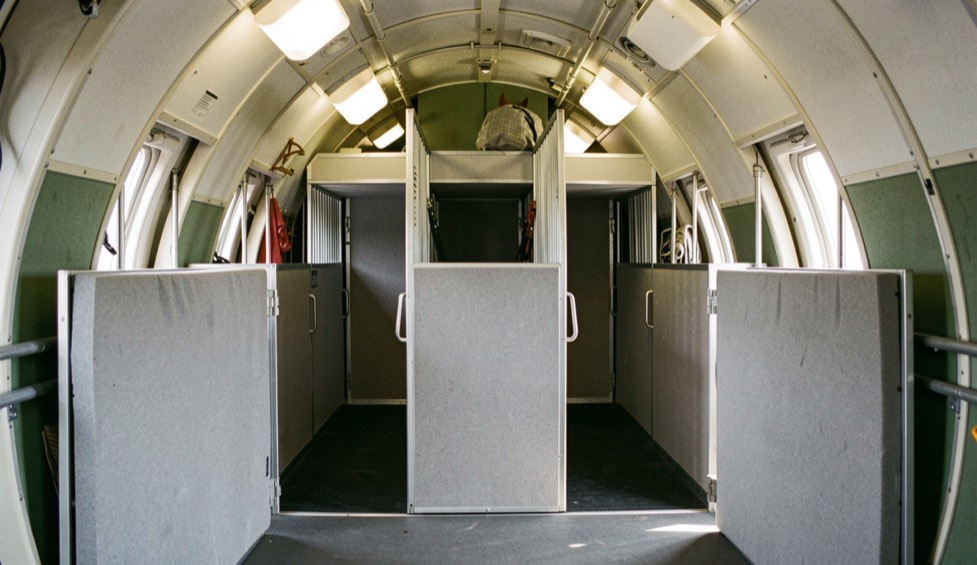
A horse does not fly in a padded room. It flies in a metal box built to the footprint of an aircraft pallet position, locked into the main deck of a freighter like any other unit of cargo, and opened only by people cleared to be on that deck. The trade calls it a jet stall, an air stall or a horse unit load device. It is the single object that decides how much the flight costs, how the animal travels and what the groom can do once the doors are shut.
What separates a jet stall from a lorry box
A road box travels on suspension, at ground level, with a driver who can pull over. A jet stall has none of that. It sits on a flat pallet base that mates with the roller floor of the aircraft, so the whole assembly is pushed aboard by a high loader rather than walked up a ramp into the vehicle itself. Once the locks are set the box cannot be moved until the aircraft is on the ground again. The floor is flat and slip resistant rather than sprung, the sides are solid to shoulder height and open above, and access is from the front, because on a loaded main deck there is no room to walk around a stall.
Who writes the standard for the box?
Not the airlines individually. The container standard for horses is written by IATA in the Live Animals Regulations, and horses are covered by Container Requirement 2. That is not an inference: IATA publishes its list of significant changes free of charge, and the list for the 49th edition records amendments to Container Requirement 2 in the sections "CONTAINER CONSTRUCTION: Size; Frame; Sides; Floor; Roof; Aircraft Horse Transport ULD", plus "PREPARATIONS BEFORE DISPATCH" and "FEED AND WATERING". The same list records amendments to section 10.4.1, described as "further clarity on specific handling procedures for horses".
The full text of Container Requirement 2 is a paid IATA publication. This ledger therefore names the requirement and quotes what IATA publishes openly, and does not reproduce its dimensions, clearances or stocking figures. Anyone shipping a horse needs the current edition itself, not a summary of it.
Why the IATA standard is also a legal test in Europe
In the European Union the IATA container rule is not merely trade practice. Council Regulation (EC) No 1/2005 on the protection of animals during transport, at Annex I, Chapter II, section 4, states that "Animals shall be transported in containers, pens or stalls appropriate for the species, which comply with International Air Transport Association (IATA) live animals Regulations, in its version referred to in Annex VI". The regulation therefore imports a private industry manual into public law.
There is an oddity worth knowing before anyone argues about which edition applies. Annex VI of the consolidated regulation still names the "International Air Transport Association (IATA) live animals regulations 31st Edition, 1 October 2004", while IATA has published a new edition every year since and was presenting the 53rd edition, for 2027, when this page was written. In practice carriers work to the current edition, because the airline that accepts the shipment applies its own acceptance checklist; but the text of the regulation has not been moved forward with them.
The partitions, and why they change the invoice
The same frame is sold as a one horse, two horse or three horse stall depending on where the internal partitions are set. That is the commercial reality behind the airline shorthand of first, business and economy class for horses: the animal is not offered a different aircraft, it is offered a different share of the same box. Fewer horses per stall means more lateral room, easier access for the attendant and a higher price per animal, because the freight charge follows the pallet position, not the passenger. The decision is taken at booking, since the partitions are set on the ground and the pallet position is reserved as a whole. A mare that needs room, a young horse that has never travelled shut in, or a stallion that cannot share, each turn a three horse frame into a two horse or a single one, and the quotation moves with it.
What can the attendant actually reach in flight?
The front, and little else. Access is designed around the front of the stall. The front gate opens or drops so that a head can be reached, a haynet retied and a bucket offered. Tie rings hold the head collar rope short enough that the animal cannot turn but long enough that it can lower its head. Bedding is kept shallow and absorbent so that it does not travel through the hold as dust. Everything else, the partitions, the roof net, the rear gate, is set on the ground and not touched again until the box is unloaded. This is why the loading sequence on the apron is deliberate rather than hurried: whatever is not right when the stall is closed will stay that way for the whole flight, and the person sitting beside the box will be able to see the problem without being able to correct it.
What this page does not claim
The illustration on this page is a produced image, not a photograph of a specific certified container, and nothing here should be read as certifying a particular model of stall. No dimension, weight or stocking density is given, because the ledger has not read the paid text that sets them. The binding documents are the current IATA Live Animals Regulations and the acceptance conditions of the carrier that will actually fly the animal, and the two are read together on the day by the people who load.
Sources read on 5 September 2026: IATA, Significant Changes and Amendments to the 49th Edition of the Live Animals Regulations; IATA, Live Animals Regulations; EUR-Lex, consolidated Council Regulation (EC) No 1/2005, Annex I Chapter II section 4 and Annex VI.