Jet Stalls
From paddock to box: the first loading
The airport day is won or lost weeks earlier, in a yard, one plank and one bucket at a time.
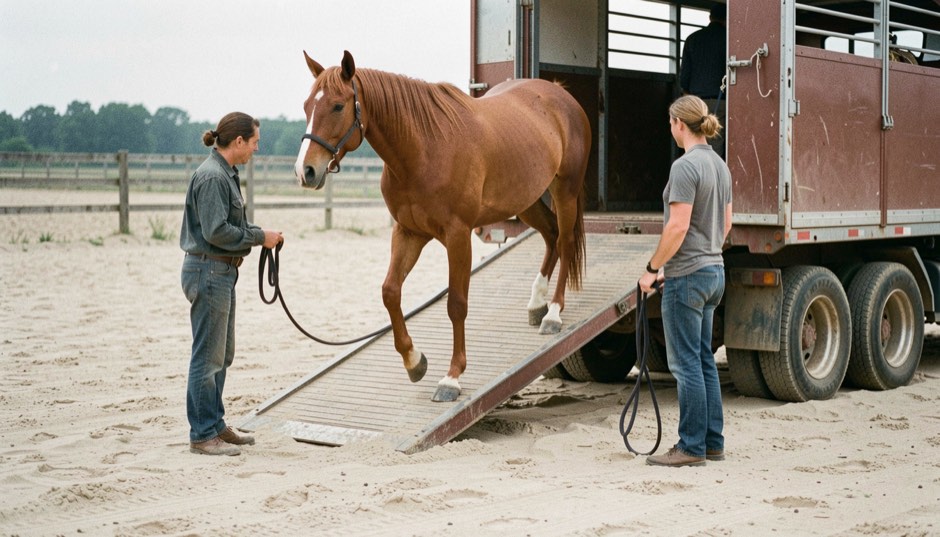
Nothing about an air shipment is improvised on the day. The horse that walks calmly into a jet stall on a cargo apron is almost always a horse that has been loading into boxes for weeks, in a quiet yard, with nobody watching a clock. The airport is a bad classroom: it is loud, it smells wrong, the ground vibrates and the people are strangers. Whatever the animal has not learned by then, it will not learn there.
Why is the preparation not optional?
Because European law makes the animal's condition a precondition of the journey rather than a courtesy. The summary of Council Regulation (EC) No 1/2005 published by EUR-Lex puts the test plainly: "the animals must be fit for transport". A horse that fights the box, injures itself loading or arrives soaked in sweat before the aircraft has moved is a horse that can be refused by the attending veterinarian, by the ground handler or by the captain. Refusal on the day costs the whole booking, because the pallet position was reserved and the certificate has a clock running on it.
What the yard sessions are actually training
Three separate behaviours are being built, and they are easy to confuse. The first is walking onto a surface that moves and sounds hollow. The second is standing still inside a confined space with a person at the head and a barrier behind. The third, and the one most often skipped, is accepting that the box is closed and stays closed while nothing happens for a long time. A horse that loads beautifully and then panics after ten minutes of stillness has learned only the first behaviour, and the flight will ask for the third for hours at a stretch.
A practical order of work. Feed in the open box on the ground for several days. Then close the front while the animal eats. Then close it and wait, extending the wait. Only then add movement. Reversing that order teaches the horse that being shut in predicts being frightened.
The differences the horse will still meet on the day
Even a well prepared animal meets things a yard cannot reproduce. The jet stall is narrower than most road boxes and open above shoulder height, so the light is different. The box is lifted, not driven: the high loader raises the whole stall to main deck level, which is a slow vertical movement with no forward motion to explain it. Ground power units and auxiliary power units run continuously nearby. And the animal is loaded well before departure, so the first hour inside the box is spent stationary on an apron, with people passing and nothing to eat but the net that was hung on the ground. None of that can be rehearsed; what can be rehearsed is the animal's habit of standing quietly when it does not understand what is happening.
What should the shipper have ready in the yard?
Four things, none of them expensive, all of them easy to forget until the lorry is at the gate.
- The head collar and lead that will actually be used, not a show set that will be swapped at the last minute.
- The hay the horse eats at home, in the quantity the flight will need, so the gut is not changed on the same day as everything else.
- A written note of the animal's normal resting respiration and demeanour, so that the attendant in flight has a baseline instead of a guess.
- Shoes dealt with according to the carrier's acceptance conditions, which are agreed in advance and not discovered on the apron.
The note is the item that is skipped most often and missed most keenly, because the person who knows what this horse looks like when it is calm is usually not the person sitting beside it in the air.
Reading the loading honestly
A horse that hesitates at the ramp and then walks on is not a problem. A horse that loads only when pushed by three people is a problem that has been postponed, not solved, and it will reappear on a cargo apron in front of a crew that has a slot time. The useful question in the last week is not "will it load" but "will it load quietly, alone, with one handler, on the fifth attempt of the week". If the honest answer is no, the honest response is to move the date, not to hope. A postponed shipment costs a rebooking; a refused one costs the booking, the certificate window and, sometimes, the quarantine place at the other end.
What this page does not claim
This is a general account of preparation, not veterinary or training advice for a named animal. Fitness for transport is assessed by the veterinarian who signs, and acceptance is decided by the carrier. No timetable of sessions is given because the right one depends on the horse, and a schedule that is right for one animal is wrong for the next. The image above is a produced illustration, not a photograph of a particular yard or horse.
Sources read on 5 September 2026: EUR-Lex, EU rules on the protection of animals during transport; EUR-Lex, consolidated Council Regulation (EC) No 1/2005. The anatomy of a jet stall describes the box this preparation is aimed at.