Quarantine
CEM quarantine for breeding horses
A second quarantine that has nothing to do with the flight, applies only to entire horses, and involves two test mares.
Contagious equine metritis is a venereal bacterial disease, and the United States protects itself against it with a quarantine that sits alongside the ordinary import quarantine rather than inside it. Owners of geldings and of young stock never meet it. Owners of breeding stock meet it as a second facility, a second bill and several more weeks.
Who is caught by the rule, and who is not?
The Animal and Plant Health Inspection Service states the test precisely: horses that are "sexually intact, over 731 days of age, and from a region or country affected by CEM are subject to CEM quarantine before being allowed into the United States, unless they have an import permit waiver". Three conditions, all of which must be met. A gelding is out. A two year old that has not yet passed 731 days is out. A horse from a region not affected by contagious equine metritis is out.
None of this examines the animal's own breeding soundness. CEM quarantine is a border control, not a health certification, and the buyer of a breeding animal reads a second file for that. In dogs, a breeder-written guide to canine eye certification sets out how that second file works: the registries, the examination codes and the annual retest calendar.
731 days is not a rounded figure. It is two years plus a day, and it is checked against the passport, not against the birth year.
What happens to a mare?
A sequence rather than a wait. APHIS describes testing of mares as an initial complement fixation blood test for contagious equine metritis, then three sets of culture swabs taken over a twelve day period, followed by five days during which the external genitalia are scrubbed and coated with an antibacterial ointment. The mare is not simply held; she is sampled repeatedly, because a single negative culture is not treated as proof. The organism can be carried without any sign, which is the whole reason the disease is controlled by testing rather than by observation, and it is also why the mare's calendar cannot start until she is in the approved facility: the swabs have to be taken there, by the people the protocol names, on the days it sets.
What happens to a stallion, and to two other mares
The stallion protocol is the part that people do not expect, because it involves animals that were never imported. APHIS describes it as one set of culture swabs from the external genitalia, followed by live cover breeding to two test mares. The stallion's external genitalia are then scrubbed and coated with an antibiotic ointment for five days after the test breeding. Beginning on day three after breeding, culture swabs are collected from the test mare on three separate occasions over a twelve day period, and the test mares are themselves tested by complement fixation between days 21 and 28 after breeding.
In other words, the diagnostic subject is partly the resident test mares, not only the imported stallion. That is why the calendar for a stallion runs past four weeks after arrival, and why the facility must be equipped for covering and not merely for isolation.
Where this happens
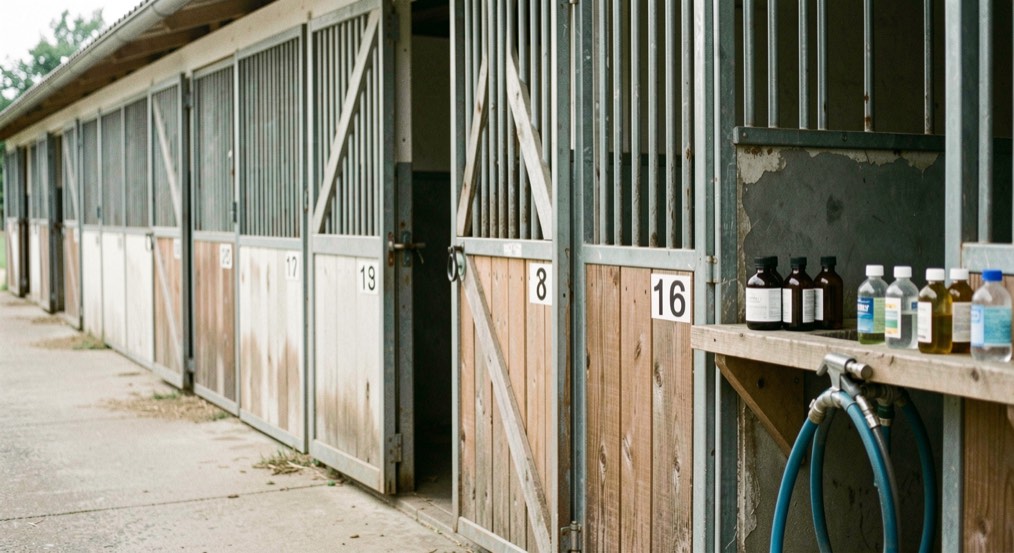
These are not federal centres. APHIS states that "Each CEM quarantine facility is State-approved and -operated, with APHIS oversight". The practical consequence is that availability, conditions and cost vary by state, and that the importer books a place in a specific approved facility rather than drawing on a national pool. The agency also states that horses under quarantine will not be bred, collected or subjected to genital examination or cleaning beyond what the testing protocol requires. For a stallion this means the facility has to hold suitable test mares of its own, and a place is only a place if those mares are available on the dates the protocol will need them.
Planning around it
Four decisions, all taken before the horse leaves, decide whether this regime is a nuisance or a crisis.
- Decide early whether the horse will travel entire. Gelding before export removes the whole regime, and that is a commercial decision, not a veterinary one.
- Book the CEM facility at the same time as the import quarantine, not after arrival.
- For a stallion, count from the test breeding, not from landing: the test mares' own complement fixation results fall between days 21 and 28 after that breeding.
- Ask whether an import permit waiver applies before assuming the full protocol, because the published rule expressly allows for one.
The waiver is worth a question rather than an assumption either way: it exists in the rule, and only the agency can say whether a given horse qualifies.
What this page does not claim
The protocols above are summarised from the agency's own published description and guidance references, not from a clinical manual, and they are the United States regime only. Other importing countries handle contagious equine metritis differently, and some do not impose a separate quarantine at all. No cost or duration of a facility stay is given, because those are set facility by facility. The operative documents are the current APHIS guidance and the conditions of the approved facility.
Sources read on 5 September 2026: APHIS, Contagious Equine Metritis (CEM) Testing for Imported Horses, page updated 10 June 2026, and its VS Guidance 13406.3, CEM Testing for Imported Horses at Approved Quarantine Facilities. The ordinary import quarantine is described in arrival quarantine, country by country.