Cargo Routes
Nose loader or side door
Same animal, same stall, two very different doorways into the hold, and routes exist because of that difference.
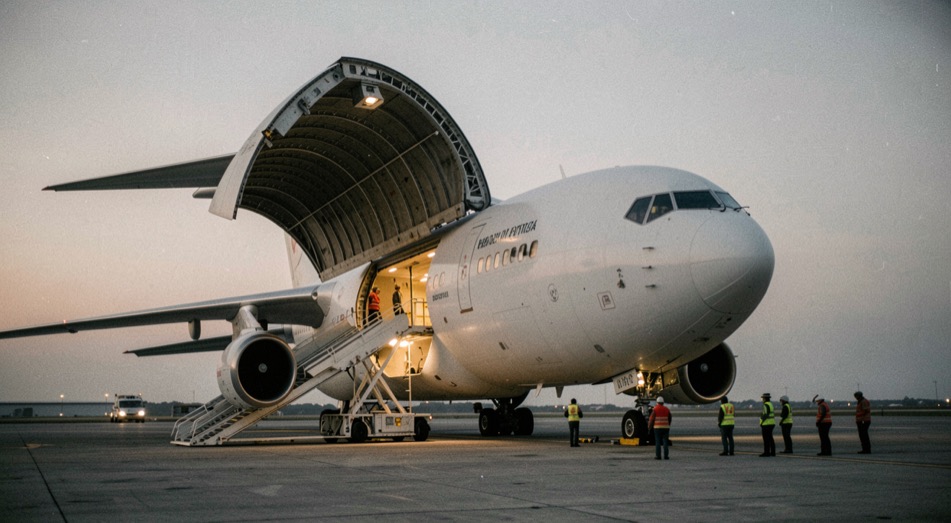
Horses do not choose airports. Doors do. A jet stall is a rigid assembly on a pallet base, and the only question that matters on the apron is whether it can physically get onto the main deck of the aircraft parked there. There are two answers, and they produce two different maps.
The main deck side door
Most freighters load through a large door in the side of the fuselage, forward or aft of the wing. A high loader raises the pallet to deck height, the pallet is rolled in through the door and pushed along the roller floor to its position, and the locks are set. The constraint is the door aperture: the stall must pass through it in the orientation the loader can achieve, and the loader itself must be tall enough and long enough for that aircraft type. Side door loading is the common case and the reason most horse charters use a small number of well equipped cargo airports.
The nose door
A smaller number of freighter types hinge the entire nose upward, so the main deck opens end on. Loading then happens along the axis of the aircraft rather than across it, which allows very long items and gives a straight run down the deck. For horse work the practical advantage is handling: a straight in path means fewer turns for a heavy, high pallet, and the crew is working with the length of the deck rather than against it. The disadvantage is the same fact seen from the airport's side: a nose door needs a loader and an apron layout that fit that opening, and the list of airports which have both is shorter still.
Neither door changes the flight for the horse. Once the stall is locked in position, a nose loaded animal and a side loaded animal are in the same place on the same deck. The door decides which airports and which aircraft are available, not how the animal travels.
Why does the door decide the map?
Because a route is built from the intersection of three lists, and the door sits in the second one. The first list is airports with cargo handling able to accept live animals. The second is airports with ground equipment matched to the aircraft type, which is where the door and the loader come in. The third is airports where the destination's veterinary border control can actually receive the consignment. A country may have a dozen international airports and only one that satisfies all three. That is why horse routings often look indirect on a map: they are not going the short way, they are going the equipped way.
Four further constraints shape the leg once the airports are known, and a shipper should recognise each of them in a quotation.
- Night curfews at the origin or destination, which can push a departure by hours and change the whole chain.
- Aircraft range against payload: a heavier load of stalls can turn a nonstop into a routing with a fuel stop.
- The border control post, which in the European Union is where the certificate lodged in TRACES is presented and the consignment is checked on entry.
- Road time at both ends, which is part of the journey the horse experiences even though it is not part of the flight.
What should a shipper ask about the leg?
Three questions settle most of it. Which aircraft type is actually planned, since the type determines the door and the loader, and therefore the airports. Which airport receives the animals, and does it hold the veterinary border facility for the destination, or does the consignment clear elsewhere and travel on by road. And is there a technical stop, because a stop is an extra hour aboard for the horse and an extra set of ground arrangements for everybody else. A fourth question is worth adding when the answer to the first is vague: what happens to the routing if that aircraft is substituted. A different type can mean a different door, a different loader and, quietly, a different airport.
Charter, part charter and scheduled cargo
The same three lists decide the commercial form. A full charter buys the aircraft and therefore the routing, at the cost of filling it. A part charter shares the deck with other shippers, which means shared timings and shared cohorts, and cohorts matter when a laboratory result at destination can hold other animals from the same shipment. Scheduled cargo puts the stall on a regular freighter service, which is cheapest and least flexible, and which subjects the booking to the ordinary priorities of a freight network. The choice is a trade between control and cost, and it is made before any of the veterinary work begins, because the certificate is written for a date and a route that the commercial form has already fixed.
What this page does not claim
No aircraft type, airline or airport is endorsed here, and this desk arranges nothing. Ground equipment, live animal acceptance and border facilities change; the operative source is the carrier and the destination authority. No price is given because freight is quoted per pallet position for a specific aircraft on a specific date. The illustration is a produced image, not a photograph of a named aircraft or operation.
Related pages of this ledger: technical stops on the ramp and destinations and routes. The European border control step is described on the export health certificate.