Cargo Routes
Technical stops on the ramp
The aircraft refuels with the animals aboard and the deck closed, and the attendant keeps the log through the noisiest hour of the trip.
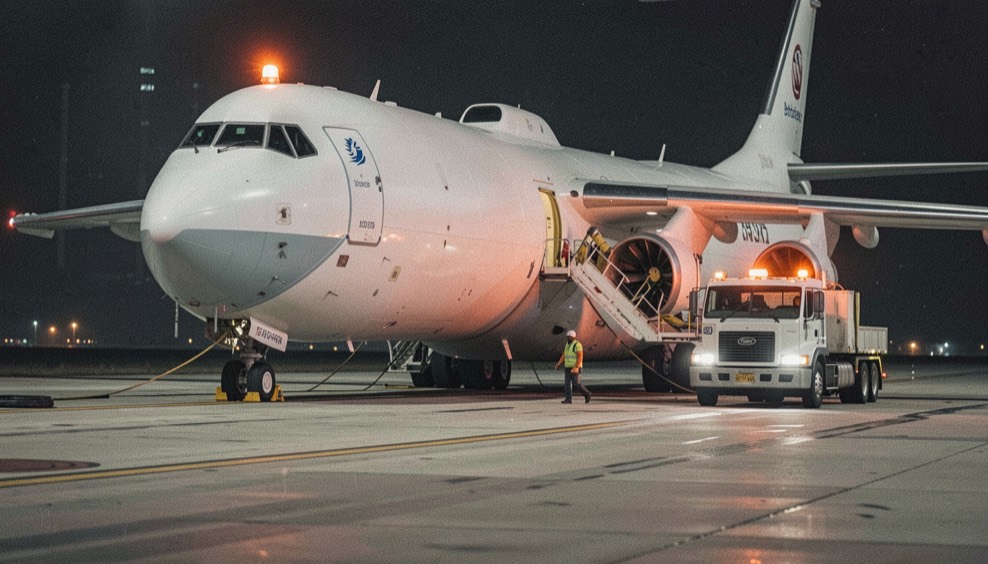
Long horse legs frequently include a stop that has nothing to do with the horses. A technical stop is a landing for fuel, for a crew change or for both, and it is planned into the routing because the aircraft cannot make the distance at that payload. For the animals it is not an interval. They stay in their stalls, on the deck, for the whole of it.
Why do the horses stay loaded?
Because unloading and reloading a horse stall is a full ground operation: a high loader, a cleared apron area, trained handlers and, at most airports, a veterinary import formality, because an animal that comes off an aircraft has arrived somewhere. A technical stop offers none of that. Keeping the stalls locked in place is both the safer option and the only legal one at most transit airports, since the consignment has not been presented for entry. It is also the quicker one: a fuel stop is planned in an hour or so of ground time, and a single stall taken off and put back would use most of it, with the rest of the deck waiting.
What changes for the animal during that hour?
Five things, and none of them is the fuel.
- The engines stop, and with them the steady noise the horses have adapted to over several hours.
- Ground power and air conditioning units take over, and their sound and airflow are different.
- Deck temperature can rise, particularly at a warm airport in daylight, because the aircraft is no longer moving through cold air.
- The floor stops vibrating, which some horses read as arrival and which can produce more movement, not less.
- People appear on the deck, since a stop is when ground staff can board.
The quiet is the change. A horse settles to a steady state, not to silence. When the engines stop, the animal that has been coping with noise for hours is given a new set of conditions to cope with, and the stop is where that shows.
What the attendant does
The groom keeps the same log through the stop, and usually does more offering of water than in the cruise, because a stationary aircraft is the easiest moment to reach a bucket safely. Hay is topped up. Anything unusual is written with the time against it, because the stop is a natural boundary in the record and the receiving veterinarian will read the flight in segments. What the attendant does not do is open a stall for reassurance while ground crew are working around the deck, or leave the deck to stretch their own legs while the doors are open: the stop is the one hour of the flight when strangers are near the stalls, and the attendant is the person who knows which horse minds.
Why a stop is planned rather than improvised
A technical stop is chosen on the ground, weeks earlier, when the operator matches the payload to the range of the aircraft. Horses are a heavy and bulky load: a deck of stalls fills the volume long before it fills the weight limit on some types, and on others the reverse is true. The planner is balancing the number of animals, the fuel required and the runway available at both ends. A stop appears when that arithmetic does not close, and once it is in the plan the rest of the chain, ground handling, crew duty hours and the destination's opening times, is built around it.
That is why a shipper cannot usually trade a stop away late in the process. Removing it means fewer animals or a different aircraft, and both change the price and the date.
Who is responsible, and what does the stop cost?
Responsibility does not transfer to the transit airport. The consignment remains with the carrier, under the captain's authority, and the shipper's arrangements continue to run. That is why a stop is a commercial matter as well as an operational one: it adds ground time, it adds a set of handling charges, and it adds a place where a delay can propagate into the destination's working hours, which matters when a border control post closes at a fixed time.
A route with a technical stop is usually cheaper than the equivalent nonstop, because the operator is buying range with time rather than with payload. The saving is real and so is the cost: more hours in the stall, one more arrival and departure cycle, and one more opportunity for the chain to slip. Whether it is the right trade depends on the animal, the total journey time and how tight the receiving quarantine booking is.
What this page does not claim
Handling during transit is set by the carrier, the transit state and the captain, and varies. Nothing here describes a specific operator's procedure, no timing given is a standard, and the description of what changes for the animal is reasoning from the conditions of a stop rather than a measured study. The illustration is a produced image, not a photograph of a named operation.
Related pages of this ledger: nose loader or side door, and a day aloft with the travelling groom, which sets the stop in the shape of the whole day.