Welfare in Flight
Hay, water and hold temperature
Welfare in flight is not a feeling. It is a haynet, a bucket and a dial, and the law says less about the dial than people assume.
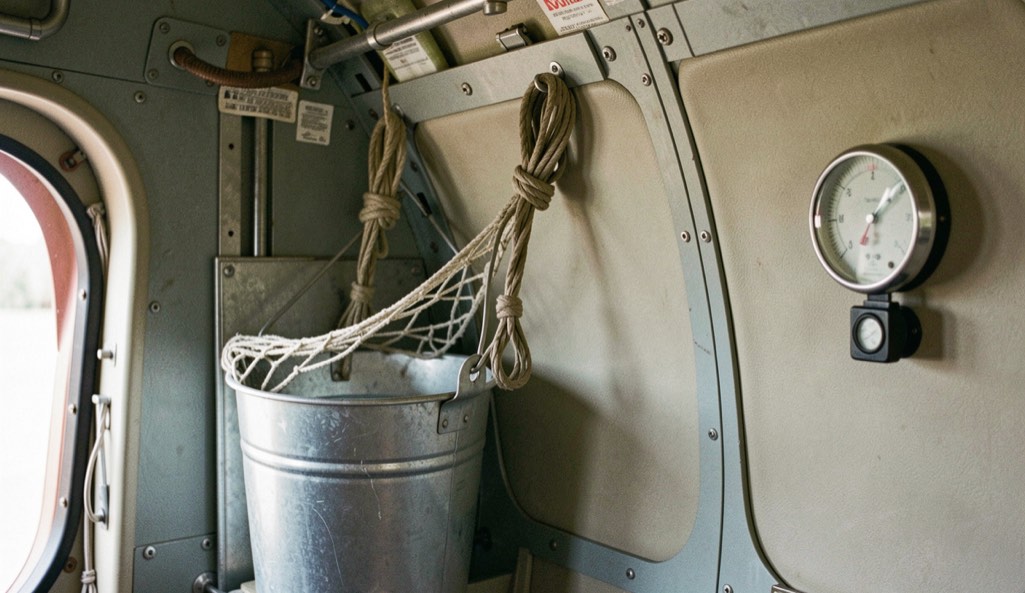
Ask what temperature a horse flies at and you will be given a number by almost everybody. Go looking for that number in the European rules and it is not there. The gap between the confident answer and the written requirement is worth understanding, because it explains who is actually accountable for the conditions on the deck.
What the European regulation requires, word for word
Council Regulation (EC) No 1/2005, at Annex I, Chapter II, paragraph 4.2, provides that "Animals shall be transported only in conditions where air quality, temperature and pressure can be maintained within an appropriate range during the entire journey, having regard to the species of animals". That is the whole of the environmental requirement for air transport. It names the three variables and then delegates the values to the species and the circumstances.
This is not an oversight, and the contrast inside the same annex makes that clear: the regulation does set explicit numerical provisions for long road journeys in Chapter VI, while for air transport it sets a standard of adequacy and points at the IATA Live Animals Regulations for the container. The legislator regulated the mode it could specify and referred the mode it could not.
For air transport the European rule is a duty of result, not a thermostat setting.
Who then decides the number?
Three parties at once, and none of them is a legislator. The aircraft type determines what the main deck environmental control system can hold and how finely it can be zoned. The operator's own live animal procedures set the target band and who watches it. And the attendant on the deck reports what the animals are actually doing, which is the only measurement that accounts for a particular horse in a particular stall. A published figure quoted without an aircraft type and an operator is close to meaningless, and this ledger does not repeat one. What a shipper can legitimately ask for is the operator's live animal procedure for the aircraft that will actually fly, and the name of the person on the deck who will be watching the animals against it.
Why is hay the simplest instrument on board?
Because a haynet is both feed and occupation, and it is the clearest honest signal available in flight. A horse that keeps eating is a horse that has settled; a horse that stops is telling the attendant something before any other sign appears. Nets are hung where the animal can reach them without lifting the head high, and they are refilled at the stop. Feeding the animal's own hay matters here for a reason that has nothing to do with taste: a gut change on the same day as a flight removes the ability to read that signal at all, because a horse off its feed for a new hay looks exactly like a horse off its feed for a reason that matters. The instrument only works if it was calibrated at home.
Water: offered, not left
Water is offered on a schedule rather than left permanently available in a moving stall, and both the offer and the response are logged. Horses vary enormously in whether they will drink in the air, and refusal in flight is common enough that it is not by itself alarming; refusal combined with a stopped haynet is a different matter. Rehydration at destination is part of the plan, not an afterthought, and it is one of the first things the receiving quarantine facility deals with. The attendant's water entries are the reason it can be dealt with quickly: a veterinarian who knows the animal drank at the stop and refused afterwards starts from a different place than one who knows nothing.
The three welfare variables in one place
| Variable | Legal requirement in the EU | Who sets the value in practice |
|---|---|---|
| Air quality | Maintained within an appropriate range for the species | Aircraft environmental system, operator procedure |
| Temperature | Maintained within an appropriate range for the species | Aircraft type and zoning, crew, attendant reports |
| Pressure | Maintained within an appropriate range for the species | Cabin pressurisation schedule of the aircraft |
| Feed and water | Container standard, IATA Container Requirement 2 | Shipper and attendant, following carrier acceptance |
The table is deliberately short. The law's column is the same sentence three times because that is what the regulation says; the practice column is where the real differences between operators and aircraft live, and it is the column a shipper should ask questions about. The fourth row is included because feed and water are the one thing on the list the shipper has a hand in before the flight, through the hay that is sent and the baseline that is written down.
What this page does not claim
No temperature range is given here, because this desk has not verified one against a primary source that applies generally. Anyone who needs a figure should ask the operator for its live animal procedure for the aircraft type concerned. The description of how hay and water are handled is a general account of practice, not a citation of the container standard, whose text on feeding and watering is a paid publication. Nothing here is veterinary advice.
Sources read on 5 September 2026: EUR-Lex, consolidated Council Regulation (EC) No 1/2005, Annex I Chapter II paragraph 4.2 and section 4, and Annex VI; IATA, Significant Changes and Amendments to the 49th Edition. The container itself is described in the anatomy of a jet stall.