Welfare in Flight
Why sedation is usually refused
The standard does not forbid sedation outright. It removes the decision from the shipper and gives it to a veterinarian.
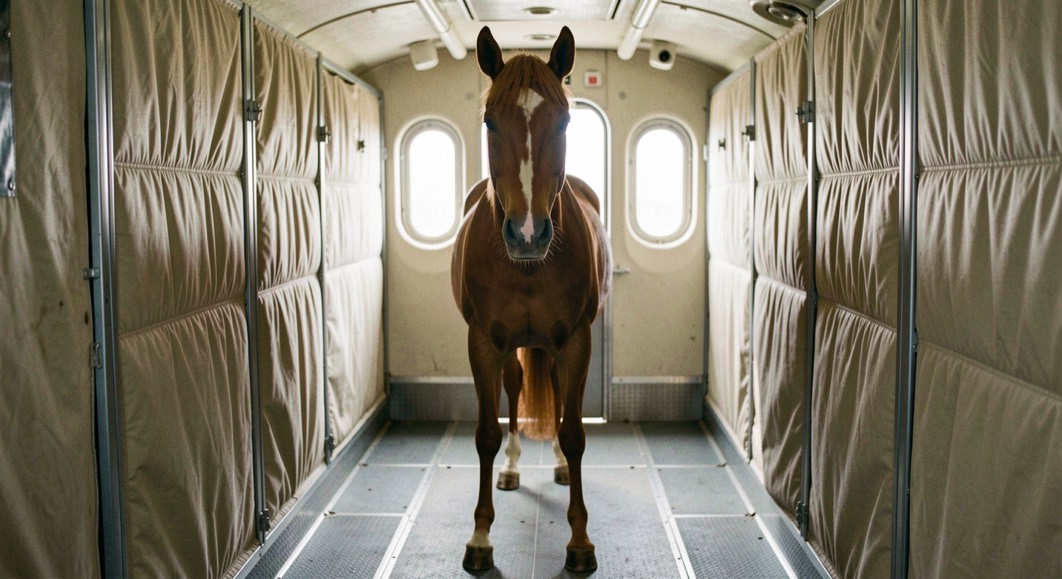
The received wisdom is that horses are never sedated for flying. The written rule is more precise than that, and more useful: sedation is not banned, it is taken out of the hands of the person who booked the shipment.
What does the industry standard actually say?
IATA's published list of significant changes for the 49th edition of the Live Animals Regulations records two relevant amendments. A new section 8.1.4.1 was added, titled "Sedation, Tranquilization and use of Psychoactive Drugs", and the same edition added a new defined term, "Sedatives, Tranquilizers and Psychoactive Drugs". Alongside it, the shipper's responsibilities in section 1.2.1 were amended "to include the responsibility of ensuring that animals are not tranquilized without veterinary approval and supervision".
The obligation is not to keep the animal awake. It is to make sure nobody sedates it without veterinary approval and supervision.
That is a shipper obligation, which means the person consigning the horse carries it, not the airline and not the groom. A yard that quietly gives a calming injection before the lorry leaves has already breached the shipper's declaration, whatever happens afterwards.
Why a horse that can balance travels better
The mechanical argument comes before the ethical one. A horse in a jet stall is standing, unrestrained except at the head, and every change of attitude, acceleration on the runway, a turn, the descent, is met by the animal shifting its own weight. That is a continuous, unconscious act of balance performed by a heavy animal on four legs in a confined space. An animal whose proprioception and muscle tone are dulled does the job less well, and the consequences of failing are worse in a box that cannot be stopped than in a lorry that can be pulled over.
There is a second reason that matters to the attendant: a sedated horse is a horse that cannot be read. The whole system of in flight monitoring rests on comparing what the animal is doing with what it normally does. Chemical calm removes the signal without removing the problem.
Where the rule bites: acceptance
Rules about medication are enforced at a single practical moment, when the carrier accepts the consignment. Acceptance is a documented check, and IATA's published change list for the 49th edition records the consolidation of the Live Animal Acceptance Checklist into section 7.6 of the Regulations. The people running that check are looking at the animal in front of them and at the declaration that came with it. A discrepancy between the two is the problem, more than the substance itself.
This is worth stating plainly because it changes who carries the risk. A yard that administers something quietly is not hiding it from a regulator in a distant office; it is hiding it from the person standing on the apron who has to decide whether to load. If that person judges the animal is not as declared, the shipment does not go, the pallet position is lost and the certificate clock keeps running.
What is done instead
Everything that makes a horse calm without making it dull, most of it arranged weeks earlier and none of it administered on the apron.
- Preparation, so that the box is familiar before the airport is not.
- Familiar hay and a full net, because chewing occupies and settles.
- Partition settings that give the individual animal the room it needs, which is a booking decision made in advance.
- Company: horses that travel together on the ground are usually kept together in the air.
- An attendant who knows the animal, which is worth more than any of the above.
The list is short because the subject is simple. A horse that has learned to stand shut in, has its own hay in front of it and a known person a few metres away does not usually need anything else, and the rare horse that does is a veterinary case, not a booking problem.
Where is sedation genuinely considered?
In veterinary cases, and only there: an animal with a specific clinical indication, assessed and managed by a veterinarian, with the carrier informed in advance and the declaration written accordingly. What the standard removes is the routine, undeclared use of a tranquilliser as a substitute for preparation. The distinction matters at acceptance, because a horse arriving on the apron visibly affected by something the paperwork does not mention is a horse the carrier may refuse, while a horse whose treatment is declared, approved and supervised is a horse the carrier can make a decision about. The rule is not against the drug; it is against the surprise.
What this page does not claim
This is not veterinary advice, and it does not reproduce the text of section 8.1.4.1, which sits inside the paid Regulations. The mechanical explanation above is a reasoned account of why the rule takes the form it does, not a citation, and no drug, dose or product is named because none is being recommended or refused. Any decision about a specific animal belongs to the attending veterinarian and the carrier.
Sources read on 5 September 2026: IATA, Significant Changes and Amendments to the 49th Edition of the Live Animals Regulations; IATA, Live Animals Regulations. The monitoring this rule protects is described in a day aloft with the travelling groom.